
Poor flow may contribute to warpage, uneven thickness or basis weight, bubbles, cracking, lower toughness and reduced yield.
RP0101 series and finished ESD packaging
Static control engineered into the material.
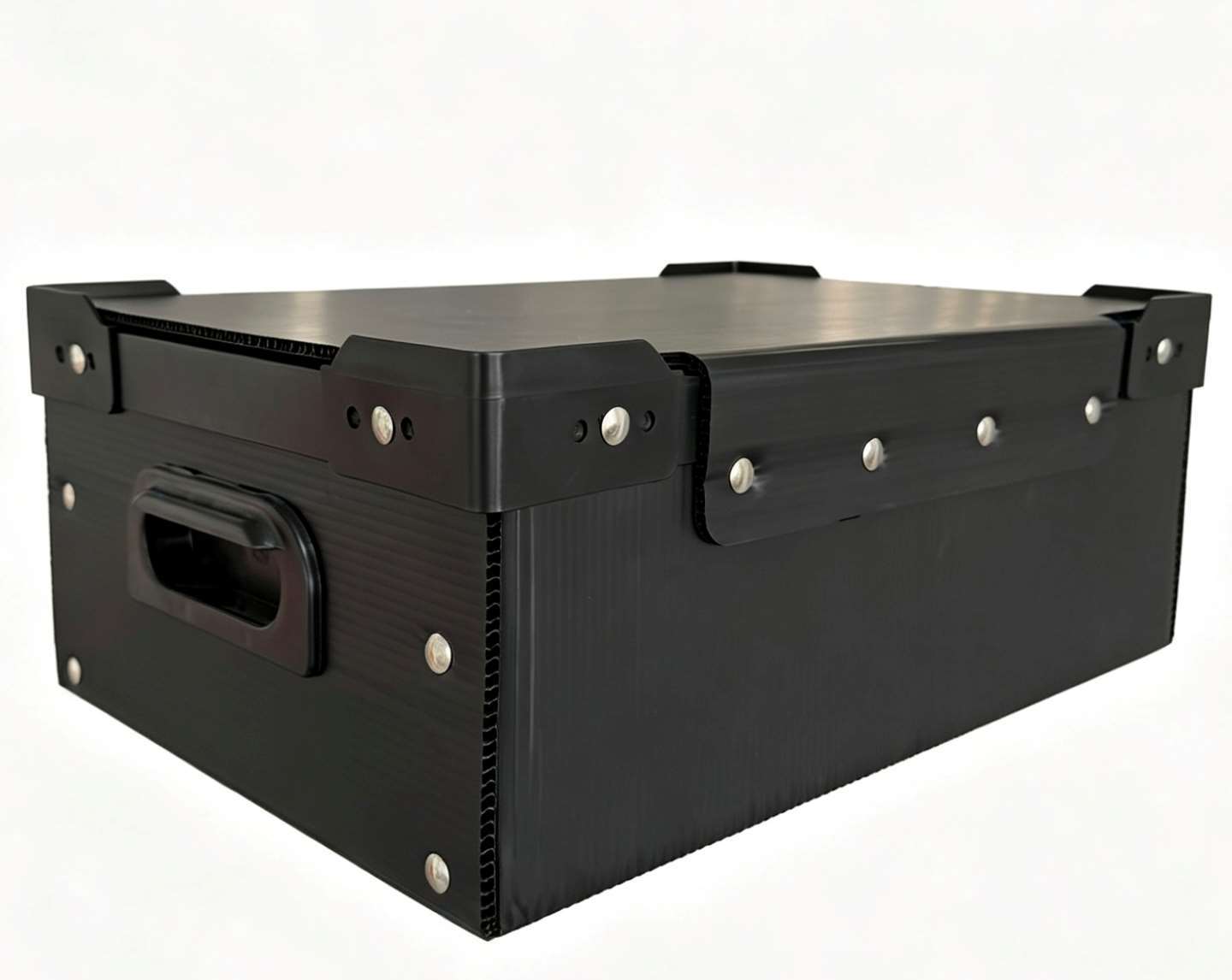
BEE ARMOR presents a one-stop ESD system spanning dedicated extrusion feedstock, corrugated hollow sheet and finished turnover packaging for electronics, semiconductors and precision components.
Manufacturer-stated rangeSurface resistance: 106-109 Ω. Test method, conditioning, sample construction and production tolerance must be agreed before North American use.
01 / Industry challenge
Conventional loading can create cost and quality tradeoffs.
The supplied technical brief states that conventional formulations may require carbon-black masterbatch loadings of about 50% to reach the 106-109 Ω range. High loading can increase raw-material cost, energy demand and processing difficulty.
Rough surfaces and carbon-black powder migration may attract dust, create uneven resistance and limit high-quality printing.
The brief identifies low scrap recovery in conventional production and a growing need for lower-waste, circular material systems.
02 / Integrated solution
Dedicated feedstock and finished packaging.
Use either layer independently or connect both around a controlled ESD packaging specification.
Dedicated ESD raw material
- Developed specifically for corrugated hollow-sheet extrusion
- Designed for direct machine feeding without complex additional pretreatment
- Stated compatibility with mainstream extrusion equipment without process-line modification
- Simplifies batching and targets higher production efficiency and yield
- Designed to resolve uneven surface-resistance performance
ESD corrugated hollow-sheet box
- Designed for electronic components, semiconductors and precision parts
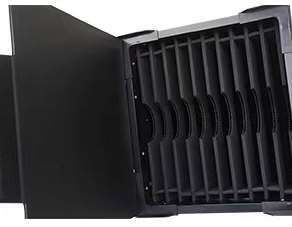
- Applicable to turnover boxes, dividers, pads and product liners
- Combines structural strength with static-dissipative protection
- Targets impact resistance, abrasion resistance and longer service life
- Supports safer transport of sensitive components
03 / Performance platform
Four technical priorities.
Stable static dissipation
Manufacturer-stated surface resistance of 106-109 Ω, described as stable despite humidity fluctuation.
Physical and surface quality
High flatness, no stated powder shedding, retained toughness and impact strength, with reduced transport damage.
Recovery and material safety
The brief states 100% closed-loop recyclability and food-contact-grade safety certification for the core raw material. Evidence must be reviewed for the intended use.
Processing and print
Direct extrusion, a clean powder-free surface and compatibility with high-definition water-based ink and digital printing.
04 / Applications
For sensitive products where dust and discharge matter.
Semiconductor protection
For wafers, chips and precision electronic components, targeting reduced static attraction and lower dust adhesion.
High-value industrial packaging
For precision instruments, optical lenses and aerospace components requiring cushioning, mechanical performance and chemical stability.
05 / Cost optimization
Reduce more than raw-material cost.
>10%Manufacturer-stated reduction in conductive carbon-black masterbatch use while maintaining target performance and improving resistance uniformity.
One-step modified material
A special fusion additive combines base resin and calcium carbonate without a secondary modification step. The formulation is described as supporting a high calcium-carbonate ratio while addressing physical-performance limits.
Yield and operating cost
Improved melt flow is intended to reduce warpage and thickness variation, scrap, rework, energy use and equipment wear.
Cleaning and asset life
A smooth, powder-free surface is intended to reduce line cleaning. Impact resistance and aging performance are positioned to extend turnover-box service life.
Print and brand value
Improved print compatibility supports clearer graphics, identification and traceability while strengthening visual presentation.
Qualification note
All performance ranges, reductions, certification and recyclability statements above reproduce the supplied Chinese technical brief in professional English. They are not presented as independent North American certification. Request test reports and validate the final construction for the intended environment.